Press Room

Press Clipping / Nov 12, 2018

Hovione bulks up, with a twist

C&EN, November 12, 2018

Guy Villax R&D Center in Portugal, Pharmaceutical Services Continuous Tableting | Hovione

A pharmaceutical services pioneer cues up continuous tableting as it doubles manufacturing.

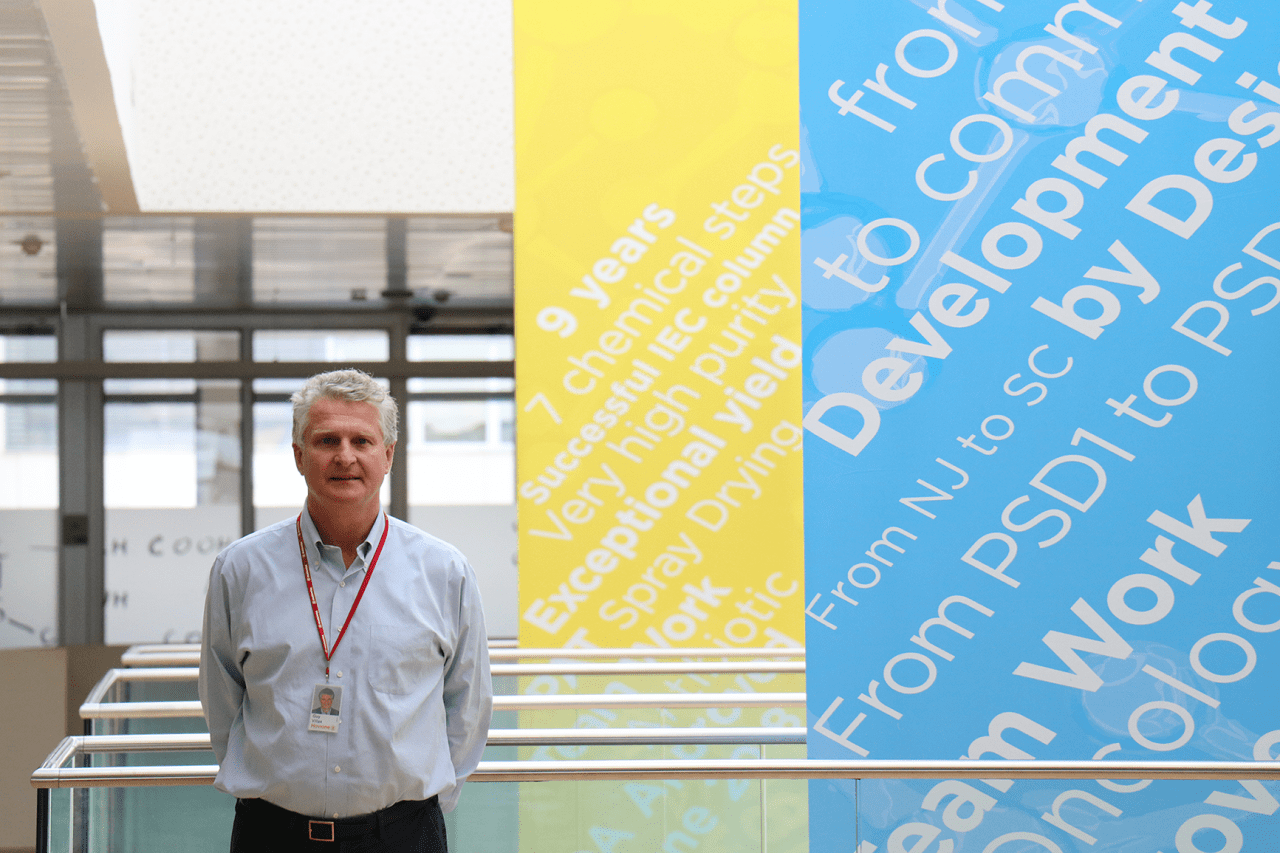
Guy Villax, CEO of Hovione, stands in the central hall of the company’s new R&D center in Lisbon. On the wall beside him is a mural with photographs commemorating the family-owned pharmaceutical chemistry firm’s milestones since it was founded by his parents, Ivan and Diane Villax, 59 years ago. There is also a nearly floor-to-ceiling portrait of Steve Jobs, the cofounder of Apple.

Guy Villax is fond of extolling innovation and inspirational figures such as Jobs and Charles Darwin, who on another mural is quoted regarding species’ responsiveness to change. That mural also nods to an evolution in how Hovione regards the scientists who work in R&D.

His father, he explains, was a man of his times. “He didn’t give much space to empowerment and all that,” he says. Villax, on the other hand, has been giving employee empowerment a lot of space recently.


The 7,000-m2 R&D center was designed with low-walled cubicles and picture windows looking into labs and conference rooms. A large tote board on the second floor lists the company’s patents, with a good number of entries—failed applications—crossed out with red lines. Banners from the ceiling celebrate the launch of new drugs for which Hovione supplied active pharmaceutical ingredients (APIs) and other services. There were four in 2017, close to 10% of the 46 drugs approved by the U.S. Food & Drug Administration.

Villax says he wants to get chemists to look up from the bench at the big picture. “It feels a little less inhuman, not doing the Charlie Chaplin things,” he says, referring to Chaplin’s skewering of the machine age in the film “Modern Times.” “If you give people a sense of what it’s all about and how they contribute, they fill in their batch records with greater care. But to keep people excited about doing new things, you have to give them the right tools.”

R&D at headquarters is one thing. Manufacturing on three continents is another, for a family-owned firm with plans to double capacity at most of its sites. But Villax sees a continuum from the lab to the plant in which developments in both realms are guided by innovative science and customer demand. It’s a philosophy that has kept Hovione afloat as many other firms in the drug service industry get swallowed up by financial buyers or big corporations.

Indeed, Hovione has been adding tools beyond the lab, including at its plant in nearby Loures, where it is doubling manufacturing capacity and starting up a finished-dosage drug plant it acquired in 2015 and then retooled.

Meanwhile, the company is adding a second pilot plant at its smaller-scale facility in East Windsor, N.J., and commissioning the second of two manufacturing buildings at a large-scale facility in Cork, Ireland, capacity that has been mothballed since Hovione bought the site from Pfizer in 2009.

The company has also added a wholly new tool in New Jersey—a continuous tableting plant­—for which it has a contract to work with Vertex Pharmaceuticals. Hovione will offer the service for other customers there and in Lisbon, where a similar plant is scheduled to be installed.

Hovione invested about $100 million in 2017 and plans to spend as much again this year and next. The plan over the next three years is to continue investing, especially in Portugal, where the firm will add 165 m3 of chemical synthesis capacity, a spray-dryer building, and a 1,200-m2 analytical lab.

Hovione’s capacity expansion is ambitious but somewhat conventional for a firm whose major investments have historically startled industry watchers. In 1985, for example, Hovione built a plant in Macau, the first instance of a European drug service company investing in China. In 2002, it opened the New Jersey plant, starting a trend of European firms establishing small-scale beachheads in the U.S.

Then came the Cork acquisition, which, in addition to bulking up manufacturing capacity with a plant Pfizer no longer needed, brought a huge spray-drying facility. Hovione pioneered and remains a leader among firms offering this now-popular service.

If anything, the move into tableting is a bit of catch-up for Villax, who not long ago spoke skeptically of peers adding final-dosage service to chemistry. The merger of DSM’s pharmaceutical chemical business with Patheon’s finished-drug service was a seeming vindication of this one-stop-shop approach. Several other firms, including Siegfried, Carbogen Amcis, and Aesica, also invested in dosage-form manufacturing, as Hovione held fast with chemistry alone.

Villax finally blinked in 2015, purchasing a plant literally over the fence from Hovione’s main site in Loures. Villax insists he would never have added dosage services if the plant weren’t adjacent to API manufacturing. He says the company now has two customers for which it does particle engineering, API synthesis, and final product manufacturing at the one site.


He emphasizes that Hovione had signed up Vertex for continuous tableting before committing to the cutting-edge technology in New Jersey. Dosage-form service “is not a leap or change in direction,” he insists. “Who do you think showed us the way? The clients.”

In New Jersey, site general manager Filipe Tomás is focused on increasing capacity for clients in the early stages of drug development. “This site cannot be at maximum capacity,” he says. “We expect to be at 60% to 70% occupancy and always be a door to customers when they have a lead.”

And that door is about to open on continuous tableting, which is beginning registration runs and is set to go into commercial production next year. Hovione’s hope that the service will be of interest is borne out several miles away at the Rutgers University Engineering Research Center for Structured Organic Particulate Systems. There, engineers have worked with Vertex and Janssen Pharmaceuticals, firms that Douglas Hausner, associate director of industrial liaison at the center, describes as early adopters. Hovione hired several students and engineers from the center as it secured the contract with Vertex.

Tomás sees the addition of tableting as a natural progression in pharmaceutical services rather than a break from Hovione’s chemistry tradition. The new apparatus, a three-story rig with a belt of tablet troughs running from top to bottom, is utterly unlike the pilot reactors elsewhere in the facility. “This is a technology that we think adds value,” specifically that of speed to market, Tomás says.

He points to a newly constructed space near the tableting machinery in which the company may add blister packaging, a service Vertex is not currently signed on for. The site has also doubled its research space with the creation of an open environment that mirrors the new Lisbon center. Along with a significant increase in staff, the New Jersey labs have increased technical firepower in areas such as particle design and engineering.

Back in Lisbon, Cláudia Ferreira, general manager of R&D services, says research and technology have seen many changes in recent years but have still followed one basic course. “Hovione always takes advantage of its core way of working, which is science driven and innovation driven. That hasn’t changed.”

Rafael Antunes, senior director of R&D, adds that remaining a family-owned company allows Hovione to take risks and make long-term investments, including in its research endeavors. “We like to be challenged,” he says. “We feel we have to differentiate ourselves from the competition, to set the bar high on the technologies we adopt, and to have the right people.”


Hovione employs about 90 Ph.D. scientists. Under a program launched five years ago, 11 Ph.D. students are doing research at the firm. The four who have completed their program have been hired by the company.

“What you have in our industry, as in so many others, is an expansion of knowledge and technology,” Villax says. “You have to keep up, and you have to solve problems faster.”

James Bruno, president of the consulting firm Chemical & Pharmaceutical Solutions, says that Villax makes some risky moves but that they tend to pay off, with the latest venture in continuous tableting appearing to be another good one.

“Sometimes I’ve scratched my head and said, ‘What is he thinking?’ ” Bruno says. “But five years later, you got to go back and say, ‘Well, you know, that was a pretty good idea.’ I think Guy always has a tendency to be a step ahead of everybody else in general. He’s doing things that people are thinking about doing.”

Villax says he’s often challenged on the question of whether, despite a good run, a major disruption in pharmaceutical technology might “get Hovione bankrupt.” This, he admits, is a good question.

But he also points to an uninterrupted line in pharmacology development that has yet to be disrupted by genomics, digital technologies, and other game-changing leaps in science.

“I think the pharmacy is something relatively unchanged for 30,000 or 40,000 years. Even when you had hunters and gatherers, I’m sure there were some people who knew what certain plants did for you. So I can’t see what is really going to disrupt us,” he says, smiling. “Famous last words!”


Read the article at C&EN online


Also in the Press Room

See All

In an interview with Executiva, a portuguese media outlet focused on women´s leadership, Diane Villax, co-founder and long-standing leader of Hovione, reflects on her journey and the company’s development over more than six decades. Diane Villax’s career began at a time when few women worked outside the home. At 19, she joined a trading company as a foreign languages correspondent, where she developed essential business skills — including commercial correspondence, banking and export procedures — that later proved instrumental in helping her husband, Ivan Villax, establish Hovione in 1959. From its earliest days operating in the family home in Lisbon, Hovione adopted an international outlook. The company’s first major customers were in Japan, setting demanding quality standards that helped shape its long-term position in global markets. Over the following decades, Hovione expanded its footprint with the construction of its first manufacturing site in Loures (1969), followed by expansion to Macau (1986), the United States (New Jersey, early 2000s) and Ireland (Cork). The company grew into a global organization with more than 2,500 employees — including over 300 scientists — and a reputation as a preferred supplier to leading pharmaceutical companies worldwide. Throughout the interview, Diane highlights the values that have guided the company’s development: a commitment to excellence, a strong work ethic, and a focus on quality and long-term relationships. Although she did not have formal business training, she learned “on the job” and brought discipline, precision and structure to her role — particularly in the company’s early financial and administrative leadership. Now in her nineties and an active member of Hovione’s Board of Directors, Diane Villax remains engaged with the company’s evolution and governance, reflecting a continued commitment to its long-term development. Her story reflects entrepreneurial drive, resilience and long-term leadership — and offers insight into the values that have shaped Hovione’s trajectory for more than six decades. Read the full interview at Executiva.pt (in portuguese).    

Article

Hovione’s Diane Villax: “I was not brought up to be a business woman”

Feb 23, 2026

Márcio Temtem, vice president, Strategic Business Management, Hovione, addresses molecule complexity, speed, and regionalization via integrated manufacturing. The landscape of small molecule manufacturing is rapidly evolving, according to Márcio Temtem, vice president, Strategic Business Development, Hovione, who provides an expert look into how his firm is evolving their approach as the industry changes. With 17 years of experience at Hovione, a family-owned CDMO with a 66-year legacy, Temtem identifies three pivotal trends currently shaping the industry: increased complexity, accelerated development speed, and the regionalization of supply chains. Temtem observes that small molecules have grown significantly in size and complexity, often requiring multiple chemical steps and high-potency handling. This shift necessitates a specialized "toolbox" to overcome modern bioavailability challenges. Highlighting Hovione's technical approach to these hurdles, Temtem states, "We use a platform called amorphous solid dispersions, produced by spray drying to address this challenge of bioavailability.” This platform represents a core area in which Hovione maintains global leadership, utilizing innovative tools to scale processes efficiently while minimizing the use of APIs. Temtem also mentions the increased influence of AI in drug discovery and deployment, which requires CDMOs to bridge the gap from grams to tons at a much faster pace than in previous years. He further addresses the trend of regionalization, noting the rise of countries such as the US and China prioritizing regional supply chain strategies. He explains that Hovione is uniquely positioned to navigate these new challenges with supply chains through its FDA-inspected sites across three continents. Central to Hovione’s competitive advantage is their integrated manufacturing offer, which combines drug substance and drug product expertise at a single location. Temtem emphasizes the value of this model, stating, “The company… has been investing in an integrated offer, bridging the problems of chemists and formulators all at the same shop.” To support this integration, the company continues to pioneer advanced manufacturing avenues, including continuous flow for drug substances and continuous tableting for drug products. Watch the full video interview or read the transcript at PharmTech.com  

Article

Hovione’s Strategy for Complexity, Speed, and Regional Supply Chains

Feb 06, 2026

Hovione’s historic site in Loures has been expanded to meet demand and is now operating at full capacity. This Lisbon-based flagship company has developed innovative production techniques to serve laboratories around the world On the outskirts of Loures, in the periphery of Lisbon, a maze of multicolored pipes covers the walls of the Hovione factory. This industrial site, where signs warn of an “explosive atmosphere,” houses the production of active pharmaceutical ingredients — the core business of this company with Portuguese origins generating annual revenues of more than half a billion euros. “The products that leave here are shipped to every continent,” explains Diane Villax, the family matriarch. At 91, her voice moves effortlessly between English, French, and Portuguese — a cosmopolitan streak inseparable from the history of Hovione and the Villax family, its founders. The epic began with an exile: that of Ivan Villax in 1948. With a toothbrush in one pocket and his chemistry degree in the other, the 23-year-old anti-communist fled his native Hungary with relatives hunted by the Soviet regime. After a stop in Clermont-Ferrand, he dropped anchor in Lisbon, where he met Diane, from a family of sugar industrialists. One year after their marriage, they co-founded Hovione in 1959 with two other Hungarian refugees. The early days were artisanal: the company’s laboratory was located in the basement of the family home. “One of my earliest childhood memories is of adults in white lab coats. I knew how to use a fire extinguisher at six!” smiles Peter Villax, son of Ivan and Diane, who worked for Hovione for more than thirty years. Very early on, the duo expanded internationally, notably into Japan. The 1980s were prosperous years: growth surged at 20% annually. Then transformation accelerated with the arrival of new technologies in the early 1990s. Today, “the time required to move from test tube to industrial scale has been reduced to a few weeks, compared with six months in the past,” notes Peter Villax. The American adventure Sixty-seven years after its creation, the company — now headquartered in Switzerland — employs 2,400 people. Through medicines incorporating its active ingredients, Hovione claims to treats around an estimated 80 million patients worldwide each year. The Loures site has been expanded, and production has spread to Ireland, the United States, and Macao. The cellar at 1 Travessa do Ferreiro, where the story began, is now a distant memory. Little known to the general public, Hovione is nevertheless a key link in the pharmaceutical value chain: it develops and manufactures molecules for 19 of the world’s 20 largest laboratories. Its expansion has been fueled by favorable market conditions. “Pharmaceutical manufacturers increasingly rely on outsourcing for the production of active ingredients,” notes Loïc Plantevin, a pharma specialist at Bain & Company. “Historically, major groups chose to allocate more capital to research than to manufacturing, while biotech companies — which now drive most of the market’s growth — are not designed to build factories.” Far from resting on its achievements, the company has transformed its offering. “While the founders initially focused on generic active ingredients, Hovione has evolved toward more complex molecules and formulations, produced within exclusive partnerships with its clients,” explains Jean-Luc Herbeaux, a French national and the company’s CEO since 2022. This shift reflects a deeper trend. “For several years now, active ingredients have become a more differentiated market and less sensitive to price,” adds Loïc Plantevin. “Competitiveness is now linked to know-how and advanced production technologies, which require substantial investment.” Hovione is the world champion of spray drying, a technology enabling the production of soluble powders. With the expansion of its New Jersey site, the company aims to double its U.S. capacity — a country that accounts for 60% of its sales. Despite Donald Trump’s attacks on the pharmaceutical sector, which he claims to have brought to heel by forcing price cuts, Hovione remains confident. “We are in the U.S. to grow, and that ambition goes beyond the momentum created by the American administration,” assures Jean-Luc Herbeaux. “Our customers there are asking us to help them produce in the United States over the long term.” Commitment to cutting-edge research and the search for talent are deeply rooted in the company’s DNA. “In his later years, my father collaborated with Nobel Prize–winning chemist Geoffrey Wilkinson. Together, they would go to the Hovione lab to run experiments — just ‘for fun,’ as they put it,” recalls Peter Villax. The group is the largest employer of PhD students in Portugal and has forged partnerships with several national universities. “In some ways, Hovione resembles a university,” he continues. “Despite the sensitive nature of our technologies, we publish many academic research papers.” In search of lost sovereignty To preserve cohesion, the Villax family adheres to strict governance. “Unlike many Portuguese family businesses, most members of the third generation do not work in the company,” notes Duarte Pitta Ferraz of consulting firm Ivens in Porto. “Several independent directors sit on the board. The family’s role is to define values and long-term vision, not to manage day-to-day operations.” This responsibility is fully embraced by Jean-Luc Herbeaux. Since joining the group in 2020 as chief operating officer, sales have doubled. “My priority was to refocus the group,” says the engineer, who previously worked for German chemical giant Evonik. “We developed spray drying, invested in a new tablet-manufacturing process, and increased production speed through a new model that allows our clients to access all our services at a single industrial site.” A member of the European Fine Chemicals Group (EFCG), Hovione is actively defending European pharmaceutical manufacturing — a sector under strain. According to a study by the French Union of Organic Chemical Synthesis Industries (Sicos), Europe’s share of global active ingredient production has fallen from 48% to 30% in ten years, to the benefit of India and China. The reasons include production cost gaps — raw materials, energy — as well as the burden of European administrative and regulatory procedures, explains Maggie Saykali, director at the EFCG. “If we start a price war with our Asian competitors, we will not win it,” she admits. “It is better to compete on quality, innovation, and sovereignty over our value chain.” It took the Covid-19 pandemic and severe shortages for Europe to awaken. Last March, the European Commission proposed legislation on critical medicines. But the race against time has already begun. “China is increasingly using pharmaceutical ingredients as a tool of geopolitical pressure,” warns Maggie Saykali. “It is urgent to preserve European players like Hovione, focused on process innovation — which allows medicines to be produced with higher quality and greater environmental responsibility.” With a new site under construction in Seixal, on the southern bank of the Tagus River, the Lisbon star has not finished shining in the orbit of the global pharmaceutical industry.   (This is a translation from the original article)   Read the original article on lexpress.fr  

Press Clipping

Hovione, the Portuguese-rooted company that has become indispensable to global pharmaceuticals

Jan 26, 2026