Press Room

Press Release / Dec 02, 2025

Hovione and GEA set new standards for continuous tableting

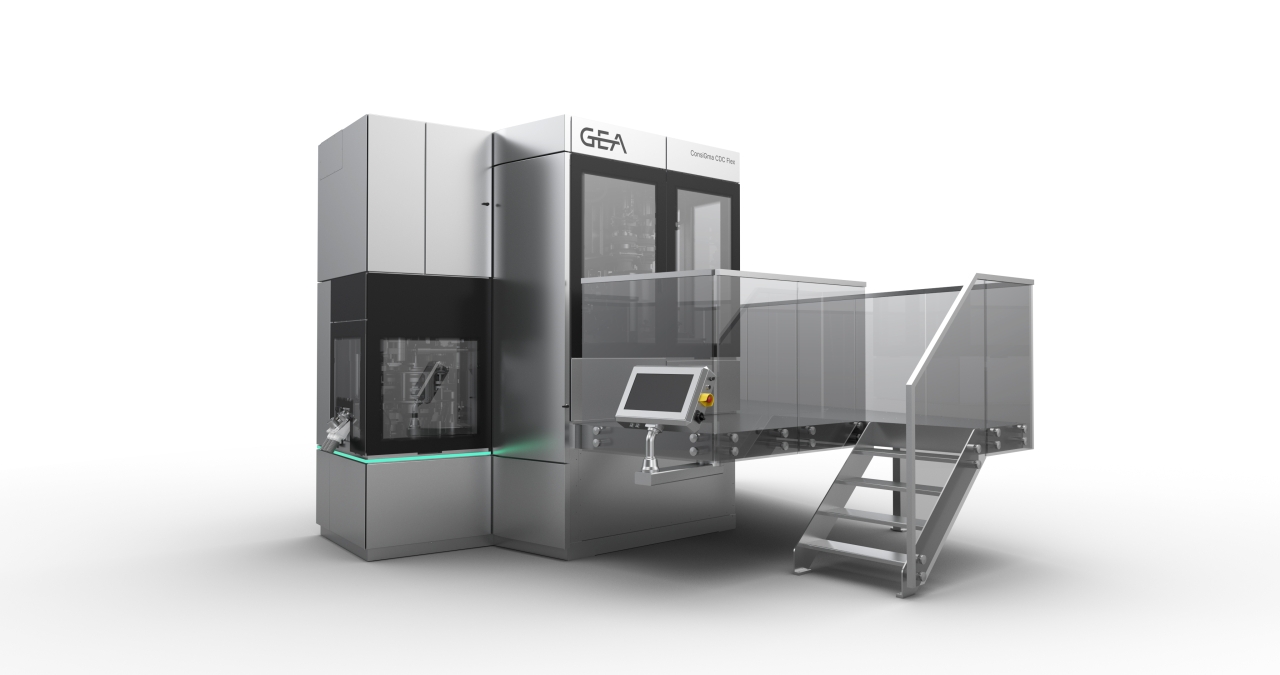
The new ConsiGma® CDC Flex delivers unprecedented flexibility, simplicity, and cost-efficiency in continuous direct compression.

The new ConsiGma CDC Flex delivers unprecedented flexibility simplicity cost-efficiency continuous direct compression | Hovione Photo:GEA

Lisbon, Portugal — December 2, 2025 — Hovione, an integrated global CDMO, and GEA, one of the world’s largest suppliers of systems and components for the food, beverage, and pharmaceutical industries, have strengthened their longstanding partnership to deliver new levels of flexibility and simplicity in continuous tableting. This enhanced collaboration has led to the development of the ConsiGma® CDC Flex system, a next-generation platform that makes continuous direct compression (CDC) more flexible, efficient, and cost-effective.

First introduced to a select audience at the GEA/Hovione Advancing Continuous Tableting Seminar in early October, and to a wider audience at the CPHI Frankfurt trade show, the new system marks a significant milestone in the partnership between the two companies.

The ConsiGma® CDC Flex represents a major leap forward in the development and production of oral solid dosage forms. Together, GEA and Hovione have developed a versatile system and a suite of automated tools — known as SimpleCT — that simplify operation, enhance efficiency and containment, and improve operator safety. These innovative developments were designed with versatility and user-friendliness in mind, and to provide a simpler workflow with automated controls and smart interfaces.

The CDC Flex is designed to operate in three different process configurations — continuously at low or high throughput, or in batch mode with immediate direct compression of pre-blended product — at output rates of 1–200 kg/h. It can also handle R&D batches as small as 1.5 kg. This is enabled by the ability to swiftly switch between different-sized continuous blenders within a single unit.

“This brand-new addition to the ConsiGma® portfolio has been designed as a truly versatile system that offers both high and low throughput functionality,” said Dr Jim Holman, Senior Director Technology Management, GEA Pharma Solids. “This agility makes the CDC Flex ideal for both R&D projects and commercial-scale production runs. In addition, for companies with a wide product portfolio that wish to benefit from the advantages that CDC offers, we now have a solution: ultimate flexibility in continuous direct compression.”

“We believe that continuous tableting delivers significant value to our customers, primarily by accelerating time-to-market through a compressed development phase and by enhancing supply chain flexibility. It also helps to reduce development costs while improving product quality and sustainability,” said Filipe Gaspar, Vice President of Technology Intensification at Hovione. “Through our collaboration with GEA, we aim to advance the continuous production of oral solid dosage forms, making the technology more standardized, accessible and cost-efficient for pharmaceutical customers.”


Also in the Press Room

See All

International Pharmaceutical Industry journal speaks with Márcio Temtem, VP Strategic Business Management at Hovione, about how the company’s deep-rooted expertise in complex chemistry differentiates it within the CDMO landscape, enables seamless integration from drug substance to drug product, and supports partners in accelerating the development of high-potency APIs, advanced formulations, and next-generation therapeutic modalities. How does your complex chemistry expertise differentiate you from other CDMOs and how does it translate into helping partners accelerate the development of increasingly sophisticated APIs and formulations? Hovione has been associated with complex chemistry since its genesis. The company started by developing very tough chemistry on corticosteroids and antibiotics, which was an expertise that in the 90s we transferred into the contract manufacturing business.  Since then, Hovione has been exploring chemistry and its complexity in contract manufacturing through several angles. One is the ability to have assets across the globe and at different scales that allow the company to address various client needs. Another example of being able to tackle the complexity is having assets that can address molecules with different levels of potency. High potency is something that we offer in many of our facilities. Over the years, we have also tackled chemistries that are difficult to manage, like hydrogenations and cryogenic reactions. All these are part of a menu that we offer into the services. Hovione is always attentive to the client’s needs. The next step after chemistry, which typically tends to be particle engineering, either by means of crystallisation, controlled crystallisation, jet milling, or one of the technologies that we master most, spray drying. We keep attentive to these needs and we keep upgrading our toolbox with new hardware and new software. On the hardware side, we recently announced a partnership with Microinnova to embed continuous flow into our offering. On the software side, we have added micellar chemistry, a water-based approach to chemically synthesise active ingredients, addressing sustainability within the broader pharmaceutical industry. How does your manufacturing approach ensure seamless integration from drug substance to drug product both technically and operationally? Hovione has sites located in Europe, Asia, and North America, designed to offer clients a seamless, integrated approach across our network, not only in terms of processes, but also in terms of technologies. These facilities serve clients globally, although naturally some clients favour the local site. In terms of integration, Hovione offers the synthesis of the active ingredient, the manufacturing of intermediates such as amorphous solid dispersions, and the final drug product all in one site. Many companies claim to offer integrated services, but they do this across multiple sites. Hovione does the integration at one site, which reduces hand-offs, streamlines operations and ensures technical alignment. How do technologies such as spray drying and particle engineering, when combined with your chemistry expertise, enhance formulation performance and streamline scale-up timelines? Spray drying has become one of the most versatile technologies in our industry. It addresses challenges that both chemists and formulators face. Chemists are often concerned with problems such as yield, purity or ways of obtaining the right solid-state characteristics of the API, such as polymorphic form. Spray drying can provide a means of isolating materials that are very difficult to isolate by other methods. Examples of compounds that benefit from this include peptides and sugars. On the formulation side, spray drying addresses one of the biggest challenges in the industry: the poor solubility and consequently bioavailability of most of the new drugs. Seventy to ninety per cent of the new drugs in development are poorly soluble. Over the past 20 years, Hovione has developed a platform for making amorphous solid dispersions by spray drying. This platform allows new formulations to be developed with minimum quantities of API and in a short number of few weeks. The technology provides a seamless scale-up from grams to tons, gives clients line-of-sight to commercial production, and saves valuable API at early stages of development. It also allows integration between drug substance and drug product, linking synthesis, intermediate manufacture, and final product in a single site, which is unique in the industry. As molecules and processes become more complex, so too do supply chains. How does Hovione ensure consistency, quality, and regulatory confidence across global operations? Hovione maintains consistency, quality and regulatory confidence through a combination of global assets, standardised platforms and processes, and cross-functional expertise. Our sites are designed to serve global clients while maintaining local responsiveness. We offer high-potency capabilities and advanced particle engineering to address complex molecular challenges. By standardising technologies and processes across sites, Hovione ensures predictable outcomes and adherence to global regulatory requirements. This integrated approach supports reliable supply chains even as molecules and processes grow more complex. With the rise of HPAPIs, novel excipients, and emerging therapeutic modalities, how is Hovione evolving its chemistry and process capabilities to support the next generation of pharmaceutical innovation? We see a trend towards more complex molecules and increasing demand for high-potency compounds. Hovione continues to invest globally, expanding capabilities in high-potency APIs, novel excipients, emerging modalities, and emerging delivery routes such as inhalation or nasal delivery. Chemistry is used as a tool to enable these delivery routes, including synthesis, crystallisation to achieve the right polymorphic form, shape, and size, and optimisation of interactions with excipients. All this is interconnected with our platforms, and amorphous solid dispersions by spray drying, designed to improve bioavailability, the one with the most market credits. Our capabilities bridge drug substance and drug product development and allow us to serve commercial products of different volumes, from small batches to larger scales, all while handling high potency and complex chemistries.   Read the full article at International-Pharma.com  

Article

International Pharmaceutical Industry journal speaks with Márcio Temtem, VP Strategic Business Management at Hovione

Mar 01, 2026