Press Room

Press Clipping / Nov 12, 2018

How Hovione grew from a basement lab to a global pharmaceutical services company

C&EN, November 12, 2018

Global Pharmaceutical Services Diane Villax Guy Villax | Hovione

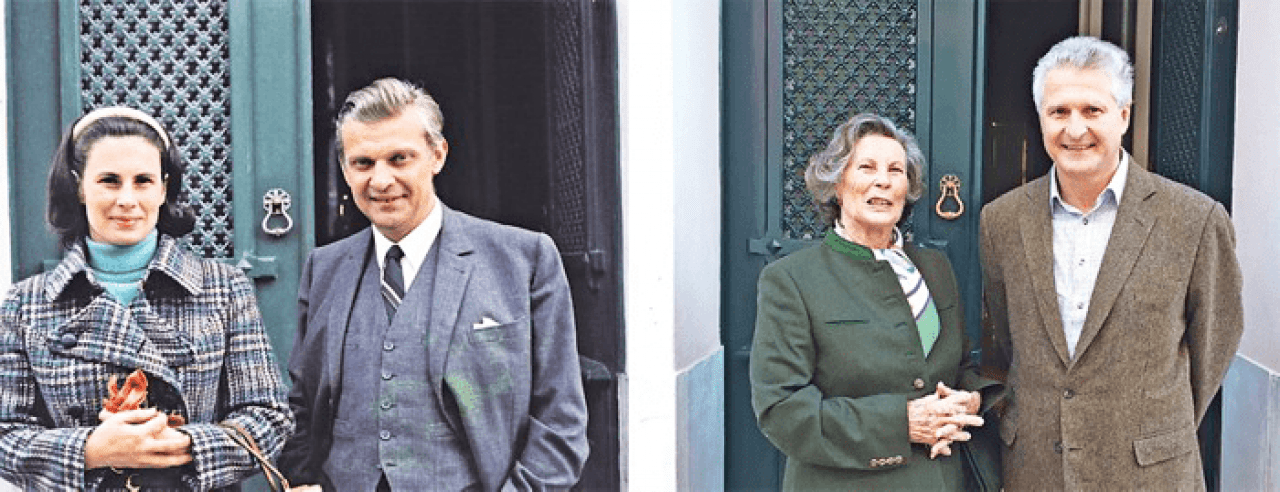
Diane Villax poses in 1962 with her husband, Ivan (left), and this year with her son, Guy, in front of the house, Guy’s current home, where she and Ivan launched Hovione in 1959.


Diane Villax, Hovione’s still-active matriarch, recounts the rise of the pioneering firm

He started, the poor chap, at the age of 23,” recalls Diane Villax of her son Guy’s debut in 1984 at Hovione, the family’s pharmaceutical chemical business. “He was thrown to the lions in the Far East. To China. He was told by his father, ‘Build me a factory in Macau. Get me some land, talk to the authorities, and build me a factory.”

This he did, she says. “He built it in 14 months, ran it for six months, and asked for an FDA inspection.”

Still marveling at the audacity of the project, Diane recounts the many roadblocks to building a factory in Macau, a former Portuguese colony, now a Las Vegas-like gaming resort, where no construction engineers were up to the project in 1984. Shipping construction materials, glass-lined tanks, and other apparatuses from Italy, Greece, and the company’s home base of Lisbon was another daunting challenge, given that the only suitable cargo port was in Rotterdam, the Netherlands.

Her daughter, Sofia, was also deployed to China, in charge of quality control at the new plant. Diane remembers Sofia calling home rattled after an interview with an inspector who brusquely dismissed the upstart plant’s chances of passing a U.S. Food & Drug Administration audit. “Poor child,” she says. “Well, they had the inspection, and it was fine, so then they all celebrated.”

Over a Saturday lunch of boiled prawns and salad on the patio of her home in a Lisbon suburb, Diane shares several other anecdotes of how she and her husband, the chemist Ivan Villax, started a company in their basement, developing fermentation processes for the manufacture of antibiotics. It has evolved over 59 years to become a major supplier of drug ingredients and associated services, with factories on three continents.

Ivan died in 2003, but at 83 Diane remains active with Hovione. She is a board member, having stepped down as chair only two years ago. Guy and Sofia are also on the board, along with four outside nonexecutive directors, including the current chair. Passing the chair to an outsider, Diane says, seemed like the thing to do now that the company has achieved a critical mass.


Born in Portugal but raised in England—her mother Portuguese, her father British—Diane Du Boulay met Ivan, a Hungarian chemist displaced by the Russian invasion after World War II, in 1956. Both their families had moved to Lisbon. Ivan came from France, where he studied microbiology, developing chemistry for penicillin, tetracycline, and other antibiotics in his spare time.

“I think he got his first patent in 1955,” Diane recalls. “He was enjoying life in Lisbon. A young man about town and a scientist and a bit of a magician at dinner parties. He was very much in demand.”

The two married and started the company with two partners, both of whom left shortly thereafter. Diane and Ivan began by selling antibiotics and other generic drugs, achieving their first big success selling betamethasone in Japan. They built a manufacturing plant on land his family owned outside Lisbon in Loures.

“Ivan was obviously the inventor, the producer, and the salesman,” she says. “Somebody had to look after the back office, issue invoices, talk to the banks, and get some money. So that was me. For 35 years, nobody signed a check except for me. I was in charge of all the imports and exports and all the licenses.”

The focus remained on generics, Diane says, until Guy came back from an InformEx exposition in the U.S. in 1993, enthusiastic about exclusive synthesis of active pharmaceutical ingredients (APIs). They got a call from Bristol-Myers Squibb shortly thereafter with a request to make an API, found a chemical engineer willing to take on the complicated chemistry, and never turned back.

Nor has Diane disengaged from oversight of the company’s business, which in one famous instance involved direct engagement with a chemical.

Early on, with Ivan on the road, Diane was awakened one night by a chemical smell in the house. She called an engineer who worked for the company, and the two identified a leaking vessel in the basement. They found an empty container. Preparing to transfer the contents of the vessel, Diane realized that someone would have to suck on the hose to get the liquid moving. The engineer demurred, noting that they had no idea what was leaking.

“I had to do it,” she says. “Somebody had to get it going.” The operation was a success, and Diane soon learned that the solvent was ethyl acetate. “My husband was rather horrified when he learned of this.”

Diane Villax was awarded Portugal’s Scientific Merit Medal at the opening of Science 2017, a science and technology meeting in Lisbon. The medal is given in recognition of contributions to the development of science and scientific culture in Portugal.


Read the article at C&EN online


Also in the Press Room

See All

The CDMO is preparing for its New Jersey facility to become fully operational this year. Hovione’s multimillion-dollar investment in expanding its East Windsor, NJ manufacturing site is quickly coming to fruition. Contract Pharma will be visiting the site later in April 2026 to provide a unique overview of what’s new. As a preview, the Contract Pharma team met with Hovione at the Drug, Chemical & Associated Technologies Association (DCAT) Week. David Basile, Vice President of Technical Operations—Americas, spoke at the opening Member Company Announcement Forum on March 23, 2026. In this interview, Basile expands on his remarks at the Announcement Forum. As he explains, Hovione is concentrating not only on New Jersey, but also on facilities in Ireland and Portugal. Contract Pharma: Good manufacturing practice (GMP) operations will soon be fully operational at the New Jersey facility. How has Hovione progressed through this process since the initial investment cycle was announced last fall—or even prior? David Basile: It’s been a really great journey and evolution over the last two to three years, conceiving the plan to grow our U.S. footprint. It was one of the reasons I came aboard with Hovione, to grow that footprint and build our commercial manufacturing prowess in the States. In New Jersey, we had originated [the site] as a tech transfer center. [But] we wanted to grow the organization to be more equivalent with our Portugal and Ireland sites, to do more large-scale manufacturing. So, this is part of that journey. And that’s not just bricks-and-mortar and machinery. It’s been people, talent, partnerships with clients, supporting functions such as QC [quality control] and analytical development. We’re growing our R&D teams as well. It’s a comprehensive approach to systems, people, and processes. CP: At the Member Company Announcement Forum, you ran through some of the major technical specifications of the NJ expansion. Can you talk about a few of the highlights and their capabilities? Basile: This year we’ll be starting up two PSD-3 scale spray dryers. This is a useful scale of machinery for our clients. It plays nicely between the PSD-2 and PSD-4 scales that we have elsewhere in the network. I’d say it’s medium-to-large scale capacity; we could do 30 metric tons annually out of this type of a unit. Product to product, that differs, but we do have products that put that kind of volume out in a PSD-3, so it’s not small-scale. Customers want to hear this because [they want to gain] efficiency with their batch size, and turnaround time. And when we campaign, we can really see significant throughput with this line up of new machinery and assets. The first machine that we will start up is a Hastelloy unit, which is unique. We took a pause [in the construction timeline] to make that upgrade, as we had a client that needed this configuration. There are additional clients that are interested in it too, because you can do acidic solutions and more aggressive kinds of formulations as well as solvent-based formulations. So that’s a unique element of that first machine. The second machine is being qualified later this year. Kind of a twin, but this one is standard 316 stainless steel.  CP: When a company brings a new or expanded facility online, new personnel often accompanies the new tech. What is the workforce addition that you expect, and what are the challenges of retaining top talent? Basile: In preparation for commissioning and startup of this new equipment, we’ve already ramped our headcount up, to be ready for GMP launch. We’ve added roughly 20 employees in preparation for this first machine to go [live]. Over the next 18-plus months, we could see something on a similar scale, getting us up to that 40–50 headcount range for that facility once it’s fully operational—and more later on in 2028, when we bring in the CDC [continuous direct compression] Flex unit. That’s what’s really going to be transformative about this new facility: that integrated offering coming to life. CP: Even if the NJ facility is top of mind right now, let’s also touch on some of your plans in Europe. What is your vision for expanding in Europe in the next two to three years? Basile: Ideally, Hovione’s aim is to build an equivalent manufacturing network, where clients can go to any site across the globe and get a similar breadth and scale of offering. We’re doing that now in Ireland, expanding our PSD-4 scale spray drying. One unit was recently installed. Late last year, it went live. Then there’s at least one other new PSD-4 in motion, which is really exciting, because [spray dryers] at this site were historically [exclusive to] larger chemistry manufacturing for API [active pharmaceutical ingredient] synthesis. So now, they’re further building their muscle with additional large scale spray drying capacity. On the Portugal side, there’s a lot of great things going on. Our Tejo campus, in Seixal, Portugal, is a massive, 4.5-million-square-foot plot of land, and there’s a new, modular facility going up there. It’s incredibly exciting. The design of the facility has been well-thought through with material flows [and] gravity-fed processes. Here, we minimize handling and [maximize] speed of processing. It’s scalable. We call each one of these building segments a finger. You can copy and paste these fingers, and they are built to house both spray drying and drug product assets within each unit. So, why is that relevant? Because we can easily scale the number of fingers. When customers say, “we need more capacity,” we have the design on the table ready to go. We know how to execute, we know how to build and implement our technology platforms in a short timeframe. Deployment timeframes are truly becoming more and more relevant to our clients. CP: From last year’s DCAT Week to this year’s, what conversations are you having with industry colleagues about ever-changing geopolitics? Basile: We’re seeing that local, regional manufacturing capacity is vital. The concept of U.S. for U.S. and China for China seems to be a common theme that our clients are talking about. We happen to have an edge, as we [have already] started our journey of expanding our domestic U.S. capacity. So I think that’s a crucial piece to the puzzle, having dual-sided Atlantic manufacturing operations. The traditional global supply chain model is being challenged. Having soup-to-nuts sites that are fully autonomous in development, scale-up, tech transfer, all the way to commercial scale operation, is vital to Hovione, and how we’re protecting our supply chain. [Concerning] starting raw materials and Tier 2 suppliers, our procurement teams are out in the market making sure that there’s no single point of failure for critical materials [like] polymers and solvents that we utilize. We’re managing and mitigating risk by looking at those secondary suppliers across different geographies. CP: Encapsulating your planned expansions on both sides of the Atlantic, how would you sum up the value to the customer? Basile: It’s about speed-to-market. It’s one partner from early-phase development, clinical scale, all the way through commercial. They gain comfort, trust, and not just capacity and equipment time; it’s also about competency and depth of scientific expertise. We’re not just a traditional CDMO. There’s unique expertise in particle science and spray dried dispersions that we offer our clients that they don’t have. [With] traditional CDMOs, customers typically pay for time in [a particular] unit, for example, they’d say: “I need a machine, and I need [it for] three weeks.” Hovione is truly a partner to our clients. They’re leveraging our platforms, our know-how in spray drying, and our know-how in equipment design. Read the article at ContractPharma.com  

Article

Hovione Eyeing Manufacturing Expansion on Both Sides of Atlantic

Apr 06, 2026

With key expansions coming to fruition on either side of the pond, specialist CDMO Hovione is making sure that drugmakers can access its particle engineering expertise across multiple geographies.  That flexibility will be key for the Portugal-based company in the coming years as the pharmaceutical industry continues to embrace more regional supply chains. In a recent interview, Hovione's David Basile, VP of technical operations for the Americas, discussed this trend and the manufacturer's expansion project, which is set to come online in New Jersey next month.  In the coming weeks, Hovione plans to debut a new spray drying expansion at its campus in East Windsor, New Jersey. The company has invested $100 million to expand its campus, including new construction and the acquisition of an additional facility and greenfield land.  Specifically, one of two pharmaceutical spray drying-3 units, or PSD-3 units, will come online in the coming weeks to tackle amorphous active pharmaceutical ingredients (APIs) and amorphous solid dispersions, according to the company. With some 80% of new small molecules in development insoluble in water, Hovione’s particle engineering and amorphous solid dispersion platform helps medicine developers improve the solubility, bioavailability, and, in some cases, the stability of their drug candidates, Basile said.  The company boasts spray dryers from the lab scale to PSD3 at its original facility in East Windsor, in addition to the pair of large-scale machines about to be activated at the campus' new facility.  “We’re going for a single, unified site with capabilities across the campus to do drug substance through finished drug product under one governance and quality system,” - Basile told Fierce.   Read the full article at FiercePharma.com

Article

As expansions come online, CDMO Hovione aims to meet industry's 'dual supply and sourcing' zeal: exec

Mar 26, 2026