Press Room

Press Clipping / Mar 31, 2020

Covid-19: Hand sanitiser effort continues

Speciality Chemicals Magazine, March 31, 2020

Covid-19: Hand sanitizer donated by Hovione | Hovione

Chemical companies continue to invest in hand sanitiser in response to the Covid-19 pandemic. A large number of them are now producing in significant volumes.

Ineos, the largest European producer of the two key raw materials - isopropyl alcohol (IPA) and ethanol – has announced its intention to produce 1 million bottles of hand sanitiser/month from each of three newly built facilities in the UK, Germany and France.

As of the end of March, the company has hit its target of building the first plant near Middlesbrough, UK. It will supply hospitals free of charge “during the crisis period” and is in discussions with retailers.

Dow announced on 30 March that its sites at Auburn, Michigan; South Charleston, West Virginia; Seneffe, Belgium; and Hortolândia, Brazil “possess the necessary raw material handling, mixing and packaging capabilities and will produce hand sanitiser”. They join the site at Stade, Germany, which is already manufacturing it.

Dow, like Ineos, was already producing raw materials, said that it could adapt its capabilities for downstream production with “little to no impact to normal operations”. Auburn can produce 7 tonnes/week and similar volumes are expected at the other sites. Once all are at full production, the company expects to produce 200 tonnes.

All of the hand sanitiser that will be produced has been allocated, with the majority for donation to state and regional health systems and government agencies for distribution. It will also be distributed to Dow production sites to help protect frontline employees. The first deliveries are expected to begin in the first week of April.

Plant-based ingredients firm Roquette has adapted one of its pilot lines at its site in Lestrem, France, to manufacture about 5,000 litres/week of a hydro-alcoholic disinfectant solution. The first shipments were sent to Lille University Hospital Centre, the French Blood Donors Organisation and to other local health facilities, in coordination with the Hauts-de-France Regional Health Agency and the local authorities.

In Germany, Wacker donated 15,000 litres of hand sanitiser for the production of disinfectants to Bavarian hospitals and care facilities at the request of the state Ministry of Economic Affairs. The alcohol needed, 11,000 liters of 2-propanol, was transported from Nünchritz, Saxony, to the Gendorf chemical industry park in Bavaria to be mixed and sent to an official distribution centre.

Swiss pharmaceutical CMDO Siegfried is also supplying disinfectant in those regions where it operates production sites, including the Swiss cantons of Aargau and Valais and around Minden in Germany. “The service including delivery is free of charge to the extent possible,” the company said, adding that it will not supply private or commercial organisations.

Meanwhile, Croda International said that it has gifted enough glycerine to regular customers to manufacture five million 250 ml bottles of hand sanitiser, assuming 2% glycerine content. It is also donating saponin vaccine adjuvants to projects working on a vaccine. The company plans to review with customers where more glycerine could be gifted.

Similarly in the US, Amyris, which is in discussions for the testing of its fermentation-derived squalene as a vaccine adjuvant for a Covid-19 vaccine, has launched its own No Compromise Pipette Baby branded hand sanitiser. The company said that it “will not price its hand sanitiser at a premium, and plans to donate part of the supply to front-line health staffers and medical personnel”. It plans to produce 30,000 units in the first few weeks.

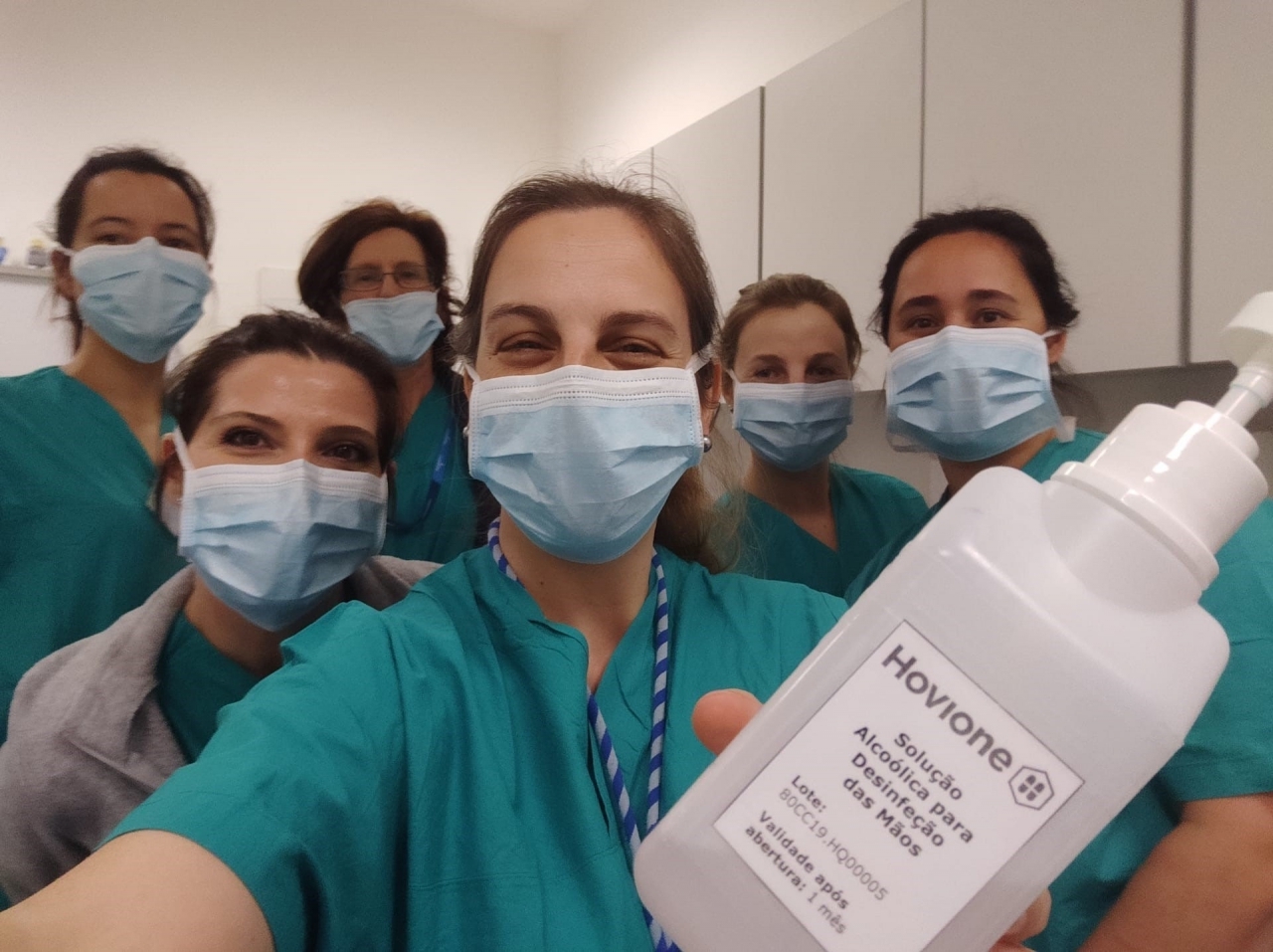
Portugal’s Hovione began producing IPA- and ethanol-based hand sanitiser to a WHO formulation at tonne-scale for itself when supplies were short, it has emerged. The company, another major pharmaceutical CDMO, is now supplying the material free to Portuguese hospitals. Volumes were expected to reach 30 tonnes by the end of the month.

Earlier in March, Lanxess added a second shift at its site in Sudbury, UK, to boost production of Vikron sanitiser. Earlier, BASF announced plans to produce hand sanitisers at Ludwigshafen and supply them to hospitals in the Rhine-Neckar metropolitan region. The company has now reallocated tonnes of raw materials, especially IPA, for making the sanitisers and secured legal official permission to make them.

Similarly, Huntsman and Syngenta began making hydro alcoholic solution to produce hand sanitiser at Monthey, Switzerland, for free-of-charge supply to hospitals and pharmacies in the Canton of Vaud and the General Hospital in Lausanne. Plans were to ramp up production to 3-5 tonnes/week. Arkema has repurpose da production line at its Rhône-Alpes Research Centre in order to make 20 tonnes/week of alcohol-based solution to be distributed free of charge for the mass restocking of public hospitals.

The effort is not limited to chemical companies, of course. Flavours and fragrance giant Firmenich has shifted production at La Plaine, Switzerland, to disinfectant solution, while luxury goods maker LVMH and many manufacturers and distillers of spirits on both sides of the Atlantic have also switched production.


Read the article at Specchemonline


Also in the Press Room

See All

A mechanical engineering graduate, this Frenchman is the CEO of the Portuguese pharmaceutical contract manufacturer Hovione. Still owned by the founding family, the company was awarded the 2025 ‘Léonardo de Vinci’ Prize, which recognizes the innovative and successful succession planning of family businesses. With an international career behind him, Jean-Luc Herbeaux is almost more fluent in English than in his native language. At 58, this Frenchman with iceberg-blue eyes is the CEO of Hovione. Founded in the late 1950s, this Portuguese group, with 100% family ownership, has just received the ‘Léonardo de Vinci’ Prize, which highlights entrepreneurial successes tinged with family legacy. While this mid-sized company with a turnover of €500 million maintains a low profile, its pharmaceutical contract manufacturing business is just as obscure to the general public. "Yet, the market for contract manufacturers, or 'contract development manufacturing organizations,' is worth $200 billion", emphasizes the CEO, who has been working in this microcosm for two decades. 500 patents Aware of the stakes, he does not deny "the pharma industry's dependence on Indian and Chinese capabilities". "The fact remains that the trend is toward the regionalization of supply chains, with European manufacturers producing for the Old Continent, American manufacturers for their own market, and so on", he says. And to highlight the foresight of Diane and Ivan Villax, the founding couple, "who thought globally from the very beginning". As a result, the group, with its 500 patents, has factories in China, the United States, and Ireland, without neglecting its home territory. This is evident by the site currently under construction on the banks of the Tagus River, following a €200 million investment. "The heavy engineering and compliance aspects are being finalized, "he explains, emphasizing that this highly regulated sector "is under a microscope". He knows this all too well, as Hovione claims to be involved in 5 to 10% of the drugs approved each year by the FDA, the American drug regulatory agency. Professor from Houston to Japan “In this small world, having a good image is important: this is the case with Jean-Luc, passionate about his work, but who knows how to demystify things”, observes Elie Vannier, former chairman of the board of Hovione. He adds that having an international profile is a strength “in this ecosystem where talent and clients are international”. For his part, Jean-Luc retains from his numerous flights “a taste for films of all genres and from all countries”. The son of an administrative employee in secondary schools and an auto insurance expert, the youngest of three children moved around according to his parents' job transfers. He was born in Meaux, grew up in Chartres, and attended the University of Technology of Compiègne, “which already offered programs abroad”. Thus, he left a mechanical engineering internship at a Dior perfume factory to join the University of Houston in Texas, "carrying a 20 kg backpack". Despite his then-limited command of English, he earned a doctorate, became a professor, and met an American woman who would become his wife and the mother of their two children. Next came the University of Kanazawa in Japan. Alas! Disappointed by the academic world, "where you have to fight to get resources", he succumbed to the allure of industry and joined the American chemical company Rohm and Haas, which had fallen under the control of the German company Evonik. 80 million patients He spent twenty years there, in Germany and Singapore, before "accepting the offers from headhunters". He then accepted Hovione's offer, who appointed him Chief Operating Officer in 2020, then CEO two years later, making him the first CEO not from the founding family. The family remains the sole shareholder, which earned the company the ‘Léonardo de Vinci’ Prize, created by the Association Les Hénokiens and the Clos Lucé. Having settled near Lisbon, he substituted walking for combat sports, "having been burned by the injuries of some friends". He also mentioned that Hovione, whose clients include 19 of the world's 20 largest pharmaceutical companies, helps treat more than 80 million patients.   (Translated version)   Read the original and full article in French on LesEchos.fr  

Article

Jean-Luc Herbeaux aims to boost the growth of the pharmaceutical group Hovione

Dec 02, 2025

The CDMO’s New Jersey manufacturing site expansion will eventually cover more than 200,000 square feet. Portugal-based contract development and manufacturing organisation (CDMO) Hovione has completed an initial $100 million investment round in its East Windsor, New Jersey site. Once completed it will increase the facility’s footprint to more than 200,000 square feet and more than double its capacity for spray drying. Hovione CEO Jean-Luc Herbeaux said: “Since launching our New Jersey operations in 2002, Hovione has been one of the longest established European CDMOs in the United States. “This investment reinforces Hovione’s leadership in spray drying – a core technology platform where we have built extensive know-how and capabilities. By continuing to advance our platforms and expand capacity in the US, we are strengthening the foundation that enables our partners to bring complex medicines to patients more efficiently.” Spray drying is an increasingly important particle engineering technology for improving drug bioavailability through the amorphous solid dispersion (ASD) that can address bioavailability or crystallisation challenges. The initial phase of Hovione’s expansion will include a 31,000-square-foot building to house two size-3 spray dryers (PSD-3) designed for ASD production. Construction at the New Jersey site is already underway and the company plans to start GMP operations in the second quarter of 2026. The initiative is part of Hovione’s long-term strategy to grow its US operations and enhance its integrated drug substance, drug product intermediate and drug product capabilities. Herbeaux said: “This investment addresses growing customer demand for US-based capacity and integrated solutions that shorten development timelines and reduce tech transfer complexity. By consolidating development, scale-up, and commercial manufacturing within a single quality and governance framework, we provide customers with seamless execution from drug substance to drug product.” The company’s New Jersey expansion fits into its wider international growth plan that also includes capacity investments in Ireland and Portugal as it seeks to create a network of autonomous sites spanning the development and commercialisation of APIs, drug product intermediates and drug products.   Read the full article at EuropeanPharmaceuticalReview.com  

Press Clipping

Hovione doubles spray drying capacity with $100m US investment round

Nov 04, 2025