Press Room

Press Clipping / Nov 12, 2018

Hovione bulks up, with a twist

C&EN, November 12, 2018

Guy Villax R&D Center in Portugal, Pharmaceutical Services Continuous Tableting | Hovione

A pharmaceutical services pioneer cues up continuous tableting as it doubles manufacturing.

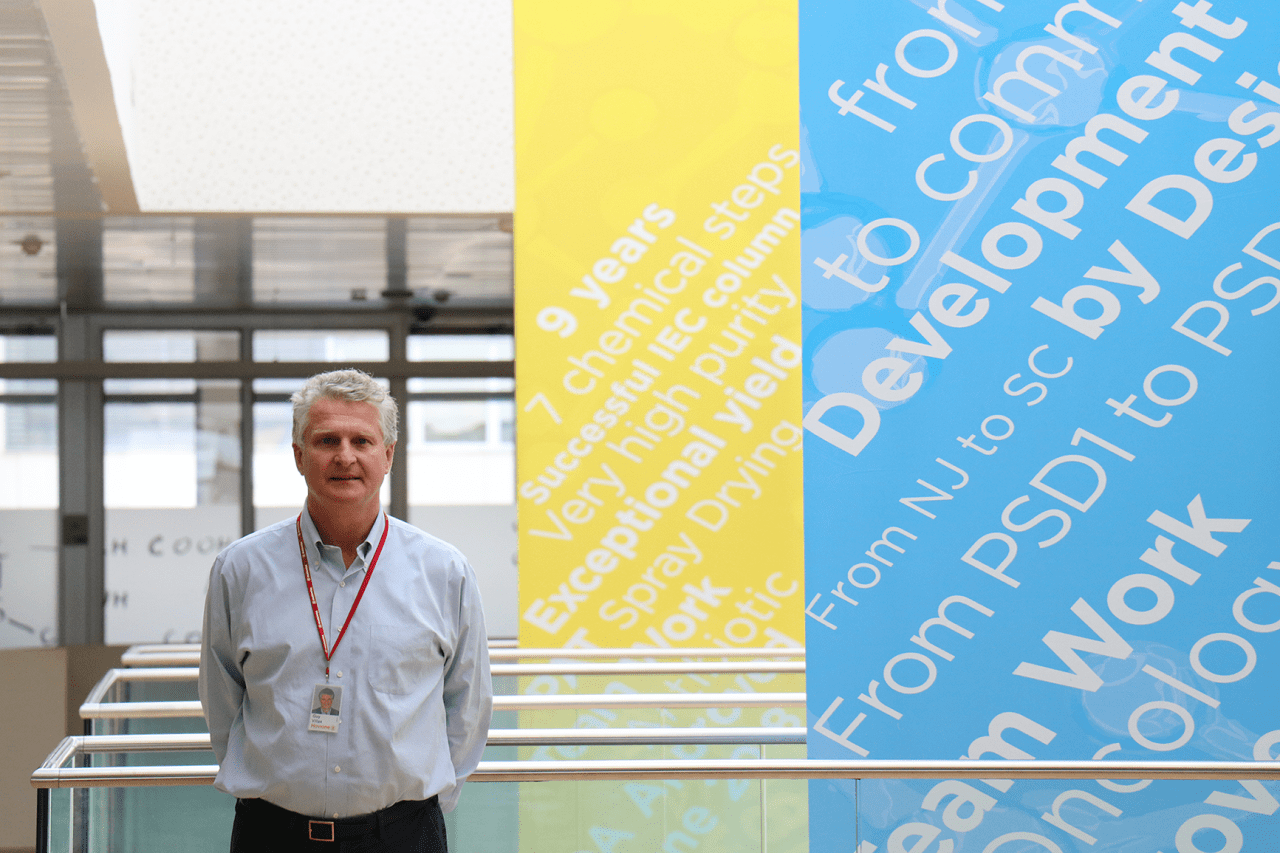
Guy Villax, CEO of Hovione, stands in the central hall of the company’s new R&D center in Lisbon. On the wall beside him is a mural with photographs commemorating the family-owned pharmaceutical chemistry firm’s milestones since it was founded by his parents, Ivan and Diane Villax, 59 years ago. There is also a nearly floor-to-ceiling portrait of Steve Jobs, the cofounder of Apple.

Guy Villax is fond of extolling innovation and inspirational figures such as Jobs and Charles Darwin, who on another mural is quoted regarding species’ responsiveness to change. That mural also nods to an evolution in how Hovione regards the scientists who work in R&D.

His father, he explains, was a man of his times. “He didn’t give much space to empowerment and all that,” he says. Villax, on the other hand, has been giving employee empowerment a lot of space recently.


The 7,000-m2 R&D center was designed with low-walled cubicles and picture windows looking into labs and conference rooms. A large tote board on the second floor lists the company’s patents, with a good number of entries—failed applications—crossed out with red lines. Banners from the ceiling celebrate the launch of new drugs for which Hovione supplied active pharmaceutical ingredients (APIs) and other services. There were four in 2017, close to 10% of the 46 drugs approved by the U.S. Food & Drug Administration.

Villax says he wants to get chemists to look up from the bench at the big picture. “It feels a little less inhuman, not doing the Charlie Chaplin things,” he says, referring to Chaplin’s skewering of the machine age in the film “Modern Times.” “If you give people a sense of what it’s all about and how they contribute, they fill in their batch records with greater care. But to keep people excited about doing new things, you have to give them the right tools.”

R&D at headquarters is one thing. Manufacturing on three continents is another, for a family-owned firm with plans to double capacity at most of its sites. But Villax sees a continuum from the lab to the plant in which developments in both realms are guided by innovative science and customer demand. It’s a philosophy that has kept Hovione afloat as many other firms in the drug service industry get swallowed up by financial buyers or big corporations.

Indeed, Hovione has been adding tools beyond the lab, including at its plant in nearby Loures, where it is doubling manufacturing capacity and starting up a finished-dosage drug plant it acquired in 2015 and then retooled.

Meanwhile, the company is adding a second pilot plant at its smaller-scale facility in East Windsor, N.J., and commissioning the second of two manufacturing buildings at a large-scale facility in Cork, Ireland, capacity that has been mothballed since Hovione bought the site from Pfizer in 2009.

The company has also added a wholly new tool in New Jersey—a continuous tableting plant­—for which it has a contract to work with Vertex Pharmaceuticals. Hovione will offer the service for other customers there and in Lisbon, where a similar plant is scheduled to be installed.

Hovione invested about $100 million in 2017 and plans to spend as much again this year and next. The plan over the next three years is to continue investing, especially in Portugal, where the firm will add 165 m3 of chemical synthesis capacity, a spray-dryer building, and a 1,200-m2 analytical lab.

Hovione’s capacity expansion is ambitious but somewhat conventional for a firm whose major investments have historically startled industry watchers. In 1985, for example, Hovione built a plant in Macau, the first instance of a European drug service company investing in China. In 2002, it opened the New Jersey plant, starting a trend of European firms establishing small-scale beachheads in the U.S.

Then came the Cork acquisition, which, in addition to bulking up manufacturing capacity with a plant Pfizer no longer needed, brought a huge spray-drying facility. Hovione pioneered and remains a leader among firms offering this now-popular service.

If anything, the move into tableting is a bit of catch-up for Villax, who not long ago spoke skeptically of peers adding final-dosage service to chemistry. The merger of DSM’s pharmaceutical chemical business with Patheon’s finished-drug service was a seeming vindication of this one-stop-shop approach. Several other firms, including Siegfried, Carbogen Amcis, and Aesica, also invested in dosage-form manufacturing, as Hovione held fast with chemistry alone.

Villax finally blinked in 2015, purchasing a plant literally over the fence from Hovione’s main site in Loures. Villax insists he would never have added dosage services if the plant weren’t adjacent to API manufacturing. He says the company now has two customers for which it does particle engineering, API synthesis, and final product manufacturing at the one site.


He emphasizes that Hovione had signed up Vertex for continuous tableting before committing to the cutting-edge technology in New Jersey. Dosage-form service “is not a leap or change in direction,” he insists. “Who do you think showed us the way? The clients.”

In New Jersey, site general manager Filipe Tomás is focused on increasing capacity for clients in the early stages of drug development. “This site cannot be at maximum capacity,” he says. “We expect to be at 60% to 70% occupancy and always be a door to customers when they have a lead.”

And that door is about to open on continuous tableting, which is beginning registration runs and is set to go into commercial production next year. Hovione’s hope that the service will be of interest is borne out several miles away at the Rutgers University Engineering Research Center for Structured Organic Particulate Systems. There, engineers have worked with Vertex and Janssen Pharmaceuticals, firms that Douglas Hausner, associate director of industrial liaison at the center, describes as early adopters. Hovione hired several students and engineers from the center as it secured the contract with Vertex.

Tomás sees the addition of tableting as a natural progression in pharmaceutical services rather than a break from Hovione’s chemistry tradition. The new apparatus, a three-story rig with a belt of tablet troughs running from top to bottom, is utterly unlike the pilot reactors elsewhere in the facility. “This is a technology that we think adds value,” specifically that of speed to market, Tomás says.

He points to a newly constructed space near the tableting machinery in which the company may add blister packaging, a service Vertex is not currently signed on for. The site has also doubled its research space with the creation of an open environment that mirrors the new Lisbon center. Along with a significant increase in staff, the New Jersey labs have increased technical firepower in areas such as particle design and engineering.

Back in Lisbon, Cláudia Ferreira, general manager of R&D services, says research and technology have seen many changes in recent years but have still followed one basic course. “Hovione always takes advantage of its core way of working, which is science driven and innovation driven. That hasn’t changed.”

Rafael Antunes, senior director of R&D, adds that remaining a family-owned company allows Hovione to take risks and make long-term investments, including in its research endeavors. “We like to be challenged,” he says. “We feel we have to differentiate ourselves from the competition, to set the bar high on the technologies we adopt, and to have the right people.”


Hovione employs about 90 Ph.D. scientists. Under a program launched five years ago, 11 Ph.D. students are doing research at the firm. The four who have completed their program have been hired by the company.

“What you have in our industry, as in so many others, is an expansion of knowledge and technology,” Villax says. “You have to keep up, and you have to solve problems faster.”

James Bruno, president of the consulting firm Chemical & Pharmaceutical Solutions, says that Villax makes some risky moves but that they tend to pay off, with the latest venture in continuous tableting appearing to be another good one.

“Sometimes I’ve scratched my head and said, ‘What is he thinking?’ ” Bruno says. “But five years later, you got to go back and say, ‘Well, you know, that was a pretty good idea.’ I think Guy always has a tendency to be a step ahead of everybody else in general. He’s doing things that people are thinking about doing.”

Villax says he’s often challenged on the question of whether, despite a good run, a major disruption in pharmaceutical technology might “get Hovione bankrupt.” This, he admits, is a good question.

But he also points to an uninterrupted line in pharmacology development that has yet to be disrupted by genomics, digital technologies, and other game-changing leaps in science.

“I think the pharmacy is something relatively unchanged for 30,000 or 40,000 years. Even when you had hunters and gatherers, I’m sure there were some people who knew what certain plants did for you. So I can’t see what is really going to disrupt us,” he says, smiling. “Famous last words!”


Read the article at C&EN online


Also in the Press Room

See All

Hovione is an international CDMO with over 60 years of experience in pharmaceutical development and manufacturing, providing a comprehensive range of services for New Molecular Entities (NMEs) including drug substances, intermediates, and finished drug products. Hovione also provides niche generic API products and delivers advanced technologies to support a variety of drug delivery systems, including oral, injectable, inhalation, and topical formats. Today, the company employs 2,500 people worldwide and offers 900 m3 of manufacturing capacity. Jean-Luc Herbeaux joined Hovione as Chief Operations Officer in 2020 and was appointed CEO in April 2022. Previously, he held multiple high-level leadership positions at Evonik, where he last headed the Health Care Business Line. Herbeaux earned a Diplôme d’Ingénieur from UTC in France and an M.S. and Ph.D. in Mechanical Engineering from the University of Houston in the U.S. In this Q&A with Contract Pharma, Herbeaux discusses Hovione’s leadership in spray drying and continuous tableting technologies, the fundamental purpose that drives the company, long-term growth strategies and more.   Contract Pharma: What are the most significant trends you are currently observing in the CDMO industry? Jean-Luc Herbeaux: Several powerful trends are currently reshaping the CDMO industry. First, we are seeing a rapid increase in the complexity of synthetic molecules. These compounds often require longer, more sophisticated chemical routes and access to specialized, qualified capacity. They also drive demand for advanced formulation technologies, particularly in particle engineering and bioavailability enhancement, where spray drying has become a key enabling platform. Second, development timelines continue to compress. Sponsors want to move faster, which significantly increases the pressure on manufacturing organizations. CDMOs are expected to design, build, qualify, and scale assets in much shorter timeframes. This challenge is amplified by the simultaneous launch of very large-volume products, where commercial capacity may not yet exist and must be created in parallel with late-stage development. These dynamics clearly favor CDMOs that already have available capacity, strong engineering depth, and proven capabilities in rapid, right-first-time scale-up. Third, the regionalization of supply chains is becoming a structural reality. Concepts such as “USA for USA” or “China for China” represent a fundamental shift for an industry that was historically optimized around globally integrated networks. CDMOs with a truly international manufacturing footprint and strong scalability are best positioned to support this transition and to meet the expectations of global pharmaceutical customers. Finally, all these forces are accelerating the evolution of customer relationships — from transactional outsourcing toward strategic, long-term partnerships. As regulatory standards tighten and customer audits become broader and more rigorous, CDMOs aspiring to be strategic partners must go well beyond technical excellence. They must demonstrate highly professionalized operations, robust quality systems, strong governance, and the ability to integrate seamlessly into their customers’ development and supply strategies. CP: How does Hovione maintain its leadership in spray drying and continuous tableting technologies? Herbeaux: Establishing and maintaining leadership demands focus, discipline and commitment to continuous improvement. Decathletes are versatile but rarely dominate a single event. Similarly, I believe pharma CDMOs must decide whether to focus on selected technologies to achieve excellence or maintain a broad offering with inevitable compromises in depth and focus. At Hovione, we have chosen to specialize, dedicating over 20 years to perfecting spray drying. Thanks to this dedication, we have built unmatched know-how in particle engineering, scale-up, and industrialization, by optimizing materials, formulation, process design, automation, hardware design, and nurturing internal talents and partnerships. Specialized CDMOs like Hovione are uniquely positioned to lead this journey, given their exposure to a far broader range of compounds than any individual pharmaceutical company encounters within its own development pipeline. Our journey in continuous tableting is more recent, yet it follows the same playbook: we apply the same disciplined, end-to-end rigor across processes, hardware, automation, talent, and partner networks to drive usability and adoption. We do so by weaving innovation and continuous improvement into everything we do, with all our team members and partners contributing. This specialized approach has made Hovione very relevant to the pharmaceutical market, not by virtue of size or volume, but through the differentiation achieved in these areas of heightened focus. In turn, this contributes to the creation and reliable supply of superior therapies to the most important stakeholder group – patients. CP: How is Hovione integrating new technologies and innovations in its processes? Herbeaux: At Hovione, we believe in advancing the quality of our services through science and technology.  Our scientific expertise helps bring performance and predictability to the development and manufacturing processes we employ to deliver drug products and their intermediates to our customers, ensuring consistently high-quality results at all scales. Our approach to innovation integrates co-development with our partners and customers to adopt innovations that accelerate development and constantly improve product and process performance. Digital tools and automation—like PAT, advanced analytics, and in silico modeling—are obviously integrated in our processes to improve control, speed, and outcomes. By focusing on innovations that have a real impact, Hovione supports up to 10% of the NDAs submitted to the FDA on any given year and contributes to medicines that reach about 80 million patients. This reflects our dedication to improving patients’ lives. At the core of our identity is this fundamental purpose that guides everything our 2,500 team members do: “We are in it for life.” CP: What is Hovione’s long-term strategy to grow its U.S. operations? What progress has the company made recently? Herbeaux: The significant growth of our New Jersey site in recent years reflects the combined effect of a deliberate strategic decision to reinforce local capabilities and teams —bringing us closer to our customers and their end markets. Our “one-site-stop” approach—bringing together drug substance, drug product intermediate, and drug product capabilities at a single site under one quality system—resonates strongly with customers. This model reduces technology-transfer complexity, compresses timelines, and enables seamless execution from development through commercialization, directly addressing customer demand for accelerated timelines. We recently completed a $100 million investment cycle, including the construction of a 31,000 sq. ft. facility featuring two new commercial-scale size-3 spray dryers dedicated to amorphous solid dispersions (ASDs). This investment more than doubles our U.S. spray-drying capacity. The facility will also soon be equipped with a next-generation GEA continuous tableting line (CDC Flex) designed to accommodate a broad range of output levels, from development through commercial-scale volumes. Hovione has also acquired additional land to support a future 125,000 sq. ft. greenfield development. Together, these projects have the potential, over the next decade, to transform our New Jersey site into a fully integrated pharmaceutical manufacturing campus of more than 200,000 sq. ft. CP: What is Hovione’s growth strategy for the rest of the world beyond the U.S.? Herbeaux: The New Jersey expansion is part of Hovione’s multi-year, multi-continent investment plan to create a network of autonomous yet harmonized sites. In Seixal, Portugal, a €200 million investment in a 104-acre campus—including new production buildings, laboratories, and offices—is scheduled to open in 2027, providing clear line of sight for new business opportunities. In Cork, Ireland, a recently completed expansion nearly doubled our local spray-drying capacity. Together, these investments strengthen our key technology platforms— 1) amorphous solid dispersion via spray drying and 2) continuous tableting—enhancing capacity and ensuring redundancy to support global supply continuity. CP: Are there any recent collaborations or partnerships that have been impactful for Hovione’s trajectory? Herbeaux: Strategic partnerships with pharmaceutical companies (our customers) are particularly rewarding, as they entail long-term commitments, provide preferred access to rich portfolios and pipelines, and support our continuous evolution toward best-in-class performance. In recent years, we have secured a growing number of preferred supplier relationships, which have helped ensure long-term supply of complex drugs and intermediates for our partners while also mitigating risk in our own pipeline. Another category of strategic collaborations involves partners with capabilities that are complementary to ours. Through these collaborations, we expand our innovation ecosystem, enhance our capabilities to address the industry’s toughest challenges, and leverage top industry talent to create value that benefits and respects all participants. Our partnership with Zerion Pharma helps advance the Dispersome technology to boost bioavailability of small-molecule drugs, supported by our ASD-HIPROS intelligent screening platform to speed amorphous solid dispersion formulation development. Our technology partnerships with Dragonfly Technologies (micellar chemistry) and Microinnova (flow chemistry) enable greener, leaner chemistry. Our collaboration with GEA contributes to the higher adoption of continuous tableting with next generation continuous tableting machines, which are easier to use, more compact and address the customer requirement for accelerated development. Building on our leadership in spray drying, we are partnering in systems for respiratory drug delivery, such as dry powder inhaler device technology with H&T Presspart and nasal powder delivery devices with IDC in order to present a complete offering (API, powder, and devices) to the market. Last but not least, we are expanding our network to areas adjacent to our current commercial activities, most notably aseptic particles and formulations, with the goal of addressing drug delivery and stabilization challenges for new modalities. Our specialized synthetic sugars, which show potential in this area, came with the acquisition of ExtremoChem. We will share more details as this offering continues to mature. CP: From a sponsor’s perspective, what should companies look for when choosing a CDMO for early-phase development of complex formulations? Herbeaux: When faced with the difficult task of selecting a CDMO, I would recommend choosing a partner with proven capabilities in the relevant area—particularly when it comes to scaling from early development to commercial production. I would select a CDMO that helps the customer make the right scientific and technical decisions early, anticipating scale-up challenges before they arise. Ultimately, I would choose a partner for the long term, equipped with the right team (including management), equipment, methodologies, quality and regulatory expertise to de-risk both the clinical and commercial programs. A long-term partnership fosters a transparent, collaborative model, supported by strong data protection, with the CDMO functioning as an extension of the customer’s team.  As trust is established and team dynamics are proven, partners can successfully pursue projects even beyond the CDMO’s core technologies, leveraging close collaboration and higher levels of integration to ensure successful outcomes. In my experience, nothing delivers more long-term value than a network of trusted partners. CP: As the CDMO space becomes increasingly crowded, how is Hovione differentiating itself in the eyes of emerging biotech and mid-sized pharma clients? Herbeaux: Our customers’ trust is our most valuable asset. It underpins every collaboration we build and is earned through the depth of our scientific expertise, efficient and reliable manufacturing, strong quality systems, sustainable practices, and long-standing regulatory excellence. This foundation is reflected in the trust placed in us by 19 of the world’s top 20 pharmaceutical companies, as well as many mid-sized pharmaceutical companies and biotech organizations. That trust is never taken for granted. It is earned and reinforced through our continuous efforts to help our customers address their most complex challenges and advance their drug programs with dedication, confidence and timeliness. As a family-owned company with a stable and experienced management team, we provide a clear long-term vision and consistent strategic direction—qualities our customers value highly. Having grown organically with patient outcome in mind, we deeply appreciate that every project matters—both to our pharmaceutical partners and, most importantly, to the patients whose lives depend on the successful launch and delivery of these medicines. Emerging biotech and mid-sized pharma clients can rely on the superior level of engagement and service that has made Hovione successful. Through our integrated model, we support the development and manufacturing of drug substance, drug product intermediates, and finished drug products for both clinical and commercial applications—enabling smooth scale-up, consistent results, and accelerated timelines. Our R&D and operations teams work in close partnership, coordinated by best-in-class project management practices, to ensure fast, reliable transfer from laboratory scale to GMP industrial production, maintaining speed without compromising quality. Throughout every stage, quality and compliance remain at the core of our work, with unwavering adherence to the highest standards. Our leadership in platforms like ASD by spray drying and continuous tableting, together with our capability to drive projects to success at any scale, remains a key source of value for emerging biotech and mid-sized pharma, especially as advanced formulation challenges grow more complex.   Read the full article at ContractPharma.com  

Article

CEO Spotlight: Hovione’s Jean-Luc Herbeaux

Jan 12, 2026