Press Room

Press Clipping / Mar 31, 2020

Covid-19: Hand sanitiser effort continues

Speciality Chemicals Magazine, March 31, 2020

Covid-19: Hand sanitizer donated by Hovione | Hovione

Chemical companies continue to invest in hand sanitiser in response to the Covid-19 pandemic. A large number of them are now producing in significant volumes.

Ineos, the largest European producer of the two key raw materials - isopropyl alcohol (IPA) and ethanol – has announced its intention to produce 1 million bottles of hand sanitiser/month from each of three newly built facilities in the UK, Germany and France.

As of the end of March, the company has hit its target of building the first plant near Middlesbrough, UK. It will supply hospitals free of charge “during the crisis period” and is in discussions with retailers.

Dow announced on 30 March that its sites at Auburn, Michigan; South Charleston, West Virginia; Seneffe, Belgium; and Hortolândia, Brazil “possess the necessary raw material handling, mixing and packaging capabilities and will produce hand sanitiser”. They join the site at Stade, Germany, which is already manufacturing it.

Dow, like Ineos, was already producing raw materials, said that it could adapt its capabilities for downstream production with “little to no impact to normal operations”. Auburn can produce 7 tonnes/week and similar volumes are expected at the other sites. Once all are at full production, the company expects to produce 200 tonnes.

All of the hand sanitiser that will be produced has been allocated, with the majority for donation to state and regional health systems and government agencies for distribution. It will also be distributed to Dow production sites to help protect frontline employees. The first deliveries are expected to begin in the first week of April.

Plant-based ingredients firm Roquette has adapted one of its pilot lines at its site in Lestrem, France, to manufacture about 5,000 litres/week of a hydro-alcoholic disinfectant solution. The first shipments were sent to Lille University Hospital Centre, the French Blood Donors Organisation and to other local health facilities, in coordination with the Hauts-de-France Regional Health Agency and the local authorities.

In Germany, Wacker donated 15,000 litres of hand sanitiser for the production of disinfectants to Bavarian hospitals and care facilities at the request of the state Ministry of Economic Affairs. The alcohol needed, 11,000 liters of 2-propanol, was transported from Nünchritz, Saxony, to the Gendorf chemical industry park in Bavaria to be mixed and sent to an official distribution centre.

Swiss pharmaceutical CMDO Siegfried is also supplying disinfectant in those regions where it operates production sites, including the Swiss cantons of Aargau and Valais and around Minden in Germany. “The service including delivery is free of charge to the extent possible,” the company said, adding that it will not supply private or commercial organisations.

Meanwhile, Croda International said that it has gifted enough glycerine to regular customers to manufacture five million 250 ml bottles of hand sanitiser, assuming 2% glycerine content. It is also donating saponin vaccine adjuvants to projects working on a vaccine. The company plans to review with customers where more glycerine could be gifted.

Similarly in the US, Amyris, which is in discussions for the testing of its fermentation-derived squalene as a vaccine adjuvant for a Covid-19 vaccine, has launched its own No Compromise Pipette Baby branded hand sanitiser. The company said that it “will not price its hand sanitiser at a premium, and plans to donate part of the supply to front-line health staffers and medical personnel”. It plans to produce 30,000 units in the first few weeks.

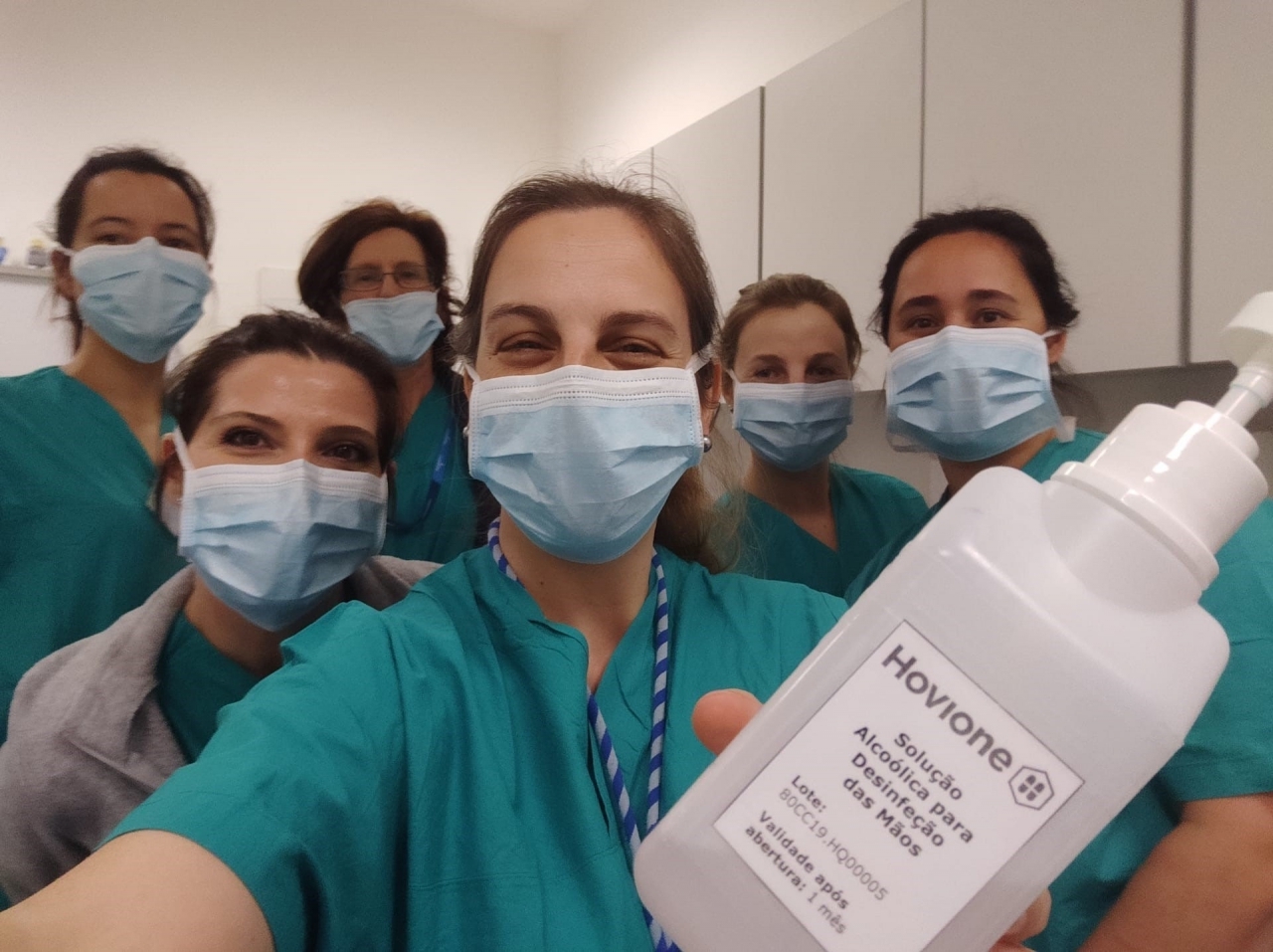
Portugal’s Hovione began producing IPA- and ethanol-based hand sanitiser to a WHO formulation at tonne-scale for itself when supplies were short, it has emerged. The company, another major pharmaceutical CDMO, is now supplying the material free to Portuguese hospitals. Volumes were expected to reach 30 tonnes by the end of the month.

Earlier in March, Lanxess added a second shift at its site in Sudbury, UK, to boost production of Vikron sanitiser. Earlier, BASF announced plans to produce hand sanitisers at Ludwigshafen and supply them to hospitals in the Rhine-Neckar metropolitan region. The company has now reallocated tonnes of raw materials, especially IPA, for making the sanitisers and secured legal official permission to make them.

Similarly, Huntsman and Syngenta began making hydro alcoholic solution to produce hand sanitiser at Monthey, Switzerland, for free-of-charge supply to hospitals and pharmacies in the Canton of Vaud and the General Hospital in Lausanne. Plans were to ramp up production to 3-5 tonnes/week. Arkema has repurpose da production line at its Rhône-Alpes Research Centre in order to make 20 tonnes/week of alcohol-based solution to be distributed free of charge for the mass restocking of public hospitals.

The effort is not limited to chemical companies, of course. Flavours and fragrance giant Firmenich has shifted production at La Plaine, Switzerland, to disinfectant solution, while luxury goods maker LVMH and many manufacturers and distillers of spirits on both sides of the Atlantic have also switched production.


Read the article at Specchemonline


Also in the Press Room

See All

The CDMO is preparing for its New Jersey facility to become fully operational this year. Hovione’s multimillion-dollar investment in expanding its East Windsor, NJ manufacturing site is quickly coming to fruition. Contract Pharma will be visiting the site later in April 2026 to provide a unique overview of what’s new. As a preview, the Contract Pharma team met with Hovione at the Drug, Chemical & Associated Technologies Association (DCAT) Week. David Basile, Vice President of Technical Operations—Americas, spoke at the opening Member Company Announcement Forum on March 23, 2026. In this interview, Basile expands on his remarks at the Announcement Forum. As he explains, Hovione is concentrating not only on New Jersey, but also on facilities in Ireland and Portugal. Contract Pharma: Good manufacturing practice (GMP) operations will soon be fully operational at the New Jersey facility. How has Hovione progressed through this process since the initial investment cycle was announced last fall—or even prior? David Basile: It’s been a really great journey and evolution over the last two to three years, conceiving the plan to grow our U.S. footprint. It was one of the reasons I came aboard with Hovione, to grow that footprint and build our commercial manufacturing prowess in the States. In New Jersey, we had originated [the site] as a tech transfer center. [But] we wanted to grow the organization to be more equivalent with our Portugal and Ireland sites, to do more large-scale manufacturing. So, this is part of that journey. And that’s not just bricks-and-mortar and machinery. It’s been people, talent, partnerships with clients, supporting functions such as QC [quality control] and analytical development. We’re growing our R&D teams as well. It’s a comprehensive approach to systems, people, and processes. CP: At the Member Company Announcement Forum, you ran through some of the major technical specifications of the NJ expansion. Can you talk about a few of the highlights and their capabilities? Basile: This year we’ll be starting up two PSD-3 scale spray dryers. This is a useful scale of machinery for our clients. It plays nicely between the PSD-2 and PSD-4 scales that we have elsewhere in the network. I’d say it’s medium-to-large scale capacity; we could do 30 metric tons annually out of this type of a unit. Product to product, that differs, but we do have products that put that kind of volume out in a PSD-3, so it’s not small-scale. Customers want to hear this because [they want to gain] efficiency with their batch size, and turnaround time. And when we campaign, we can really see significant throughput with this line up of new machinery and assets. The first machine that we will start up is a Hastelloy unit, which is unique. We took a pause [in the construction timeline] to make that upgrade, as we had a client that needed this configuration. There are additional clients that are interested in it too, because you can do acidic solutions and more aggressive kinds of formulations as well as solvent-based formulations. So that’s a unique element of that first machine. The second machine is being qualified later this year. Kind of a twin, but this one is standard 316 stainless steel.  CP: When a company brings a new or expanded facility online, new personnel often accompanies the new tech. What is the workforce addition that you expect, and what are the challenges of retaining top talent? Basile: In preparation for commissioning and startup of this new equipment, we’ve already ramped our headcount up, to be ready for GMP launch. We’ve added roughly 20 employees in preparation for this first machine to go [live]. Over the next 18-plus months, we could see something on a similar scale, getting us up to that 40–50 headcount range for that facility once it’s fully operational—and more later on in 2028, when we bring in the CDC [continuous direct compression] Flex unit. That’s what’s really going to be transformative about this new facility: that integrated offering coming to life. CP: Even if the NJ facility is top of mind right now, let’s also touch on some of your plans in Europe. What is your vision for expanding in Europe in the next two to three years? Basile: Ideally, Hovione’s aim is to build an equivalent manufacturing network, where clients can go to any site across the globe and get a similar breadth and scale of offering. We’re doing that now in Ireland, expanding our PSD-4 scale spray drying. One unit was recently installed. Late last year, it went live. Then there’s at least one other new PSD-4 in motion, which is really exciting, because [spray dryers] at this site were historically [exclusive to] larger chemistry manufacturing for API [active pharmaceutical ingredient] synthesis. So now, they’re further building their muscle with additional large scale spray drying capacity. On the Portugal side, there’s a lot of great things going on. Our Tejo campus, in Seixal, Portugal, is a massive, 4.5-million-square-foot plot of land, and there’s a new, modular facility going up there. It’s incredibly exciting. The design of the facility has been well-thought through with material flows [and] gravity-fed processes. Here, we minimize handling and [maximize] speed of processing. It’s scalable. We call each one of these building segments a finger. You can copy and paste these fingers, and they are built to house both spray drying and drug product assets within each unit. So, why is that relevant? Because we can easily scale the number of fingers. When customers say, “we need more capacity,” we have the design on the table ready to go. We know how to execute, we know how to build and implement our technology platforms in a short timeframe. Deployment timeframes are truly becoming more and more relevant to our clients. CP: From last year’s DCAT Week to this year’s, what conversations are you having with industry colleagues about ever-changing geopolitics? Basile: We’re seeing that local, regional manufacturing capacity is vital. The concept of U.S. for U.S. and China for China seems to be a common theme that our clients are talking about. We happen to have an edge, as we [have already] started our journey of expanding our domestic U.S. capacity. So I think that’s a crucial piece to the puzzle, having dual-sided Atlantic manufacturing operations. The traditional global supply chain model is being challenged. Having soup-to-nuts sites that are fully autonomous in development, scale-up, tech transfer, all the way to commercial scale operation, is vital to Hovione, and how we’re protecting our supply chain. [Concerning] starting raw materials and Tier 2 suppliers, our procurement teams are out in the market making sure that there’s no single point of failure for critical materials [like] polymers and solvents that we utilize. We’re managing and mitigating risk by looking at those secondary suppliers across different geographies. CP: Encapsulating your planned expansions on both sides of the Atlantic, how would you sum up the value to the customer? Basile: It’s about speed-to-market. It’s one partner from early-phase development, clinical scale, all the way through commercial. They gain comfort, trust, and not just capacity and equipment time; it’s also about competency and depth of scientific expertise. We’re not just a traditional CDMO. There’s unique expertise in particle science and spray dried dispersions that we offer our clients that they don’t have. [With] traditional CDMOs, customers typically pay for time in [a particular] unit, for example, they’d say: “I need a machine, and I need [it for] three weeks.” Hovione is truly a partner to our clients. They’re leveraging our platforms, our know-how in spray drying, and our know-how in equipment design. Read the article at ContractPharma.com  

Article

Hovione Eyeing Manufacturing Expansion on Both Sides of Atlantic

Apr 06, 2026

With key expansions coming to fruition on either side of the pond, specialist CDMO Hovione is making sure that drugmakers can access its particle engineering expertise across multiple geographies.  That flexibility will be key for the Portugal-based company in the coming years as the pharmaceutical industry continues to embrace more regional supply chains. In a recent interview, Hovione's David Basile, VP of technical operations for the Americas, discussed this trend and the manufacturer's expansion project, which is set to come online in New Jersey next month.  In the coming weeks, Hovione plans to debut a new spray drying expansion at its campus in East Windsor, New Jersey. The company has invested $100 million to expand its campus, including new construction and the acquisition of an additional facility and greenfield land.  Specifically, one of two pharmaceutical spray drying-3 units, or PSD-3 units, will come online in the coming weeks to tackle amorphous active pharmaceutical ingredients (APIs) and amorphous solid dispersions, according to the company. With some 80% of new small molecules in development insoluble in water, Hovione’s particle engineering and amorphous solid dispersion platform helps medicine developers improve the solubility, bioavailability, and, in some cases, the stability of their drug candidates, Basile said.  The company boasts spray dryers from the lab scale to PSD3 at its original facility in East Windsor, in addition to the pair of large-scale machines about to be activated at the campus' new facility.  “We’re going for a single, unified site with capabilities across the campus to do drug substance through finished drug product under one governance and quality system,” - Basile told Fierce.   Read the full article at FiercePharma.com

Article

As expansions come online, CDMO Hovione aims to meet industry's 'dual supply and sourcing' zeal: exec

Mar 26, 2026